OUR MANIFESTO
Knowledge
does not end.
Neither should learning.
Our mission is to give every person a tutor that knows their strengths and their gaps1, builds the next lesson on them2, learns from every session3, and lets the next learner start from what the last one found4.
The old shape
We taught everyone
the same way.
A course has always had a fixed shape: a start, a syllabus, a set amount of material, and an end. That made sense when the only way to learn was to be in the room where it was taught. The room is gone. The shape is still here.
A lecture puts one professor in front of a hundred students. An online course puts the same lesson in front of a million. That solved reach, not teaching. One student is lost because they missed a prerequisite three chapters ago. Another is bored because they already know this part. The course cannot tell them apart. It was written once, for everyone.
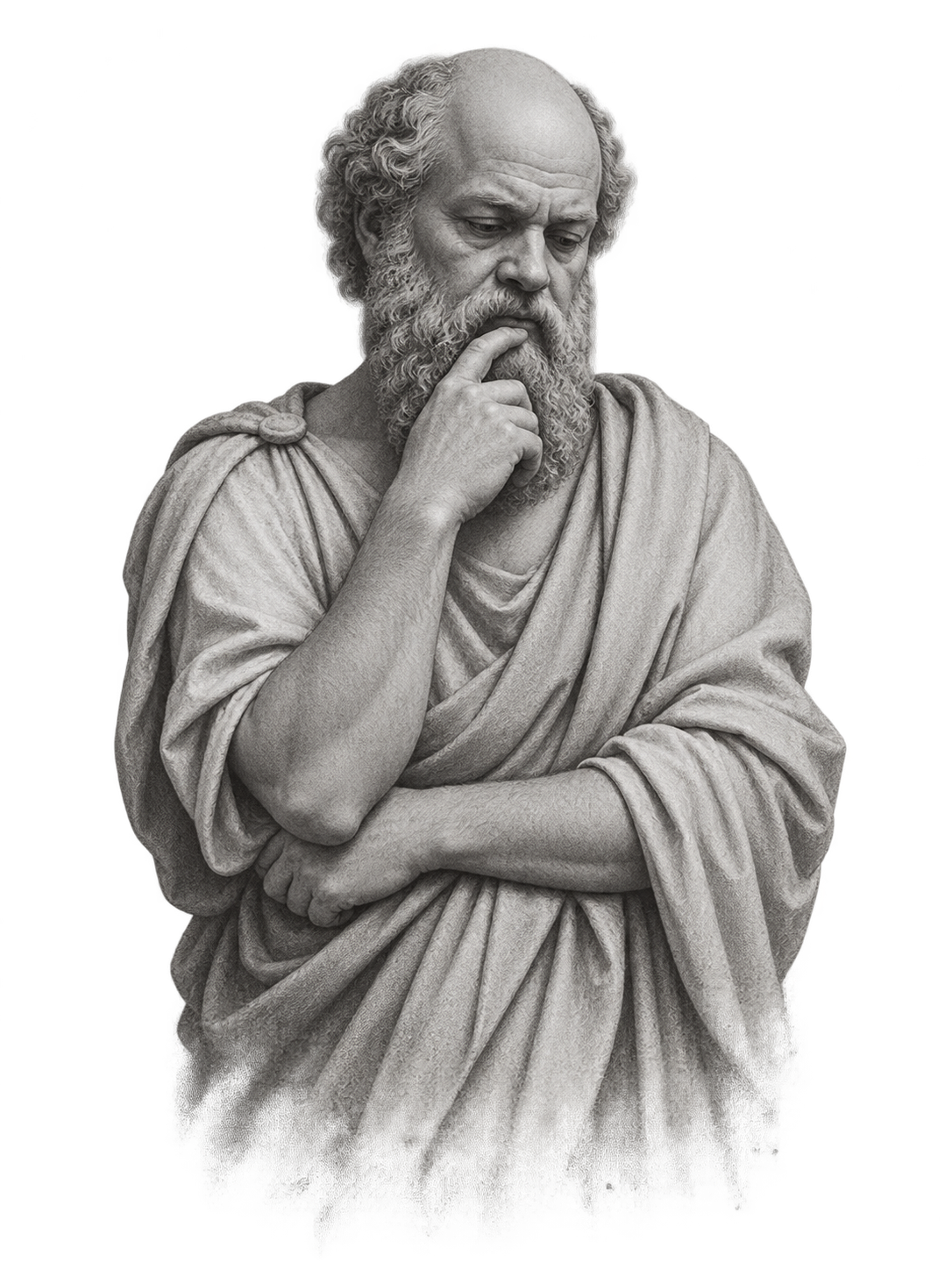
“Wonder is the only beginning of philosophy.”
— Socrates, in Plato's Theaetetus 155d5
Questions
A good teacher does not
only give answers.
A Socratic teacher starts with a question instead of a lecture. The answer tells the teacher what you understand, what you are assuming, and where the next gap is. If you already have the intuition, the next question goes deeper. If a prerequisite is missing, the lesson goes there first and comes back. The next question depends on the last answer.
In 1984 Benjamin Bloom compared students taught one-to-one against students in a normal classroom. The tutored students scored two standard deviations higher6. Nobody has scaled that result: Bloom's own conclusion was that one-to-one tutoring is too costly for most societies to bear.
Understanding
Learn to build.
Build to learn.
Feynman's test is simple: if you understand something, you can build it. You can write the code, or explain it to someone who has never seen it. If you cannot, you have found the gap. So learning and building run in a loop: you learn enough to build something, building it shows you what you did not understand, and that becomes the next thing the tutor teaches.
Trying to recall something, even unsuccessfully, makes you remember it far better than reading it again8. A course that marks you complete when you have watched everything has measured the wrong thing. Learning should produce evidence of understanding, not evidence of completion.
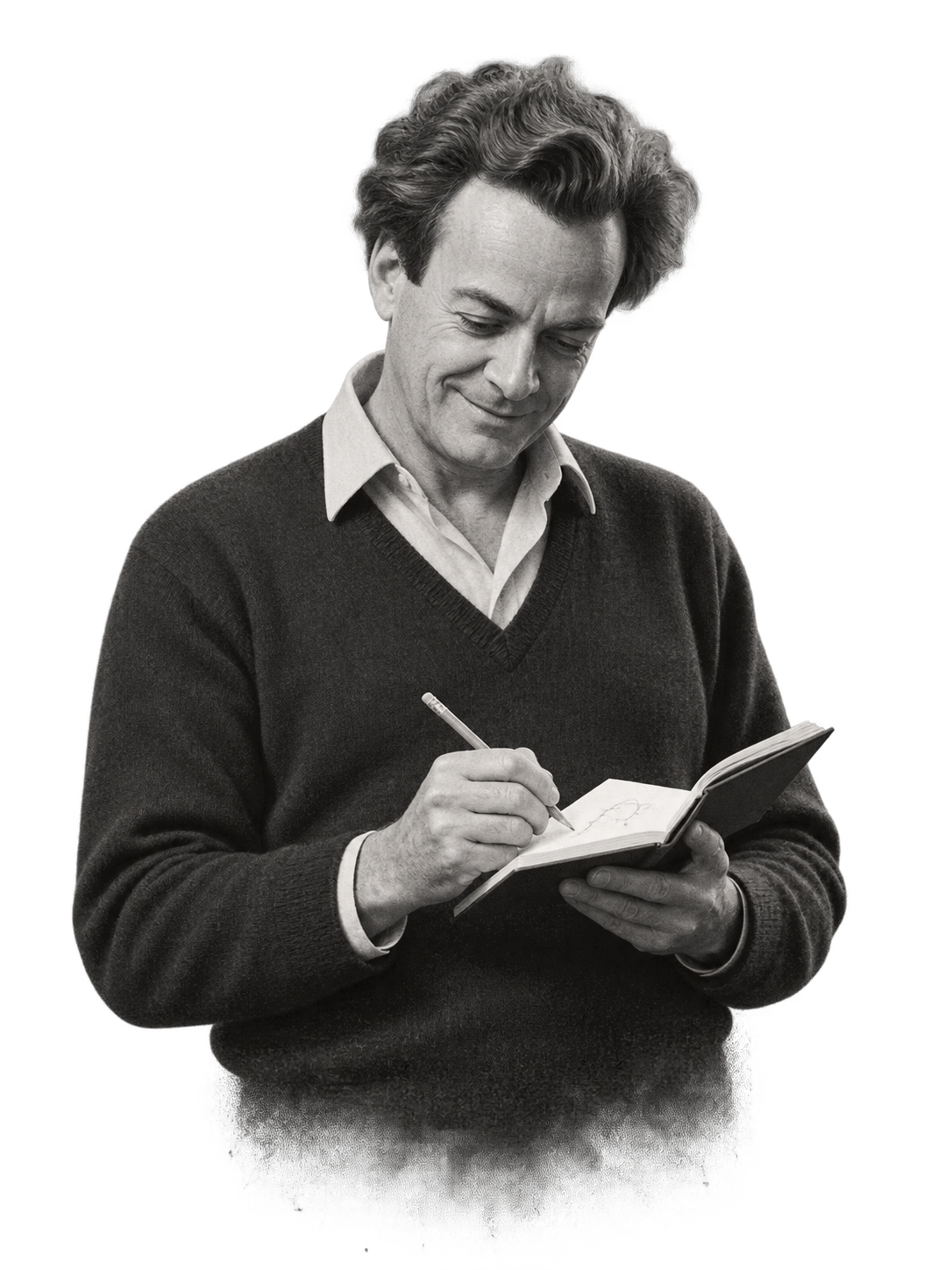
“What I cannot create, I do not understand.”
— Richard Feynman, written on his Caltech blackboard, 19887
The new era
Learning stops being
a course.
The best teaching has always been scarce and expensive: a place at a top university or an hour with an expert tutor has only ever been available to a few9. That has changed. An AI can now read any paper or repository, run the code, and answer every question you have about it. One tutor per student is possible for the first time.
The tutor adapts to the learner, not the other way round. From every answer you give, it learns what you find easy and what you do not, and chooses what to teach next. It adapts the form as well as the content: the same idea can be explained in words, drawn, run as code, plotted, animated, or built as a model. You learn it in whichever form makes it click, then test whether it did.
Learning is also no longer private. The path someone else took through a subject can be opened, copied and continued. The way you came to understand something can be shared, not just the thing itself.
What we are building
The tutor
you never had.
Rabbit Hole is an AI tutor that adapts to you. It teaches by asking, not telling, and what it explains you can change and test yourself, not just read. It is for students with a textbook, engineers with a codebase, candidates before an interview, and for anyone who teaches, from a classroom to a new hire's first week. It is not a chatbot bolted onto a course, and it is not an endless feed of AI explanations. Your sources, questions, notes, code and practice stay in one place, so the tutor sees all of it at once.
We are building it in three steps:
- Step one
- Build the tutor for one learner, on whatever they bring, in any field10.
- Step two
- Let the next person build on what the last one learned.
- Step three
- Make the tutor learn from every session, so it knows you better each time you come back.
There is no
end of knowledge.
We're building rabbit holes, not courses.
Start a rabbit holeThe Rabbit Hole team — November 2026
Appendix
- In Tutor mode you set a goal. The Tutor asks one question at a time and checks each answer before choosing the next one. There is no end to the syllabus. ↩︎
- When an answer shows a missing prerequisite, that prerequisite opens as its own rabbit hole on the canvas, with a path back to the question you left. ↩︎
- Every answer, experiment and source stays with you, and the tutor works from all of it, not just the current session. ↩︎
- A canvas can be shared by link, published to Explore under your handle, or forked so someone else continues it as their own. ↩︎
- Plato, Theaetetus 155d. https://www.perseus.tufts.edu/hopper/text?doc=plat.%20theaet.%20155 ↩︎
- Bloom, B. S. (1984). “The 2 Sigma Problem.” Educational Researcher 13(6), 4–16. The average tutored student scored around the 98th percentile of the conventional class. ↩︎
- Feynman's blackboard at Caltech, photographed after his death in February 1988. https://magazine.caltech.edu/post/biology-through-the-eyes-of-a-physicist ↩︎
- Roediger, H. L. & Karpicke, J. D. (2006). “Test-Enhanced Learning.” Psychological Science 17(3), 249–255. Students who practised recalling a passage remembered more of it a week later than students who re-read it, even though re-reading felt more effective at the time. ↩︎
- Harvard College's cost of attendance for 2026–27 is $91,634 (The Harvard Crimson, https://www.thecrimson.com/article/2026/6/29/harvard-sticker-price-inflation/). For the Class of 2030, Yale admitted 4.24% of applicants, MIT 4.58% and Columbia 4.2% (Expert Admissions, https://expertadmissions.com/class-of-2030-acceptance-rates-for-highly-selective-colleges/). UNESCO's Global Report on Teachers estimates the world needs 44 million more teachers by 2030 (UN News, https://news.un.org/en/node/1147067). ↩︎
- Today that means PDFs, Office files, notebooks, code, images, video, audio and 3D models; web pages, arXiv papers, Wikipedia articles and YouTube videos; and public GitHub repositories. ↩︎